Intelligent Video Super Resolution

SD tapes, interlaced archives, low-bitrate OTT sources — the platform automatically diagnoses degradation types, assembles the optimal restoration pipeline, and upscales to HD/4K. No manual presets: only the minimum processing the source actually needs.

Co-developed with KBS (Korea Broadcasting System).

deep learning VSR diffusion model auto pipeline deinterlace denoise x2 / x4 upscale
What It Is
AI Video Restoration Platform
Multiple deep-learning models automatically analyze degradation and perform optimal restoration.
Why Use It
Zero Manual Tuning, Maximum Quality
Source diagnosis → auto pipeline assembly → skip unnecessary stages to maximize both efficiency and quality.
Core AI Models
Adaptive Model Ensemble
Specialized restoration engines are automatically selected based on scene motion, detail, and degradation level.
Output
HD / 4K Broadcast Quality
x2/x4 upscale + QC report + thumbnails delivered together for immediate review.
1
Auto Diagnosis
Multi-stage source analysis

Interlace, noise, blur, and compression artifacts scored quantitatively before any processing.

2
Pipeline Assembly
Minimum effective path per source condition

Unnecessary stages are skipped to reduce processing time and preserve source detail.

3
Model Routing
Adaptive restoration model pool

The optimal model is auto-selected per scene characteristics: motion, blur, and noise level.

4
AI Deinterlace
AI and classical field restoration

Interlaced sources restored precisely with a combination of AI and classic algorithms.

5
Deploy Anywhere
Docker containers · Celery queue · GPU cluster

Container-native architecture ready for on-premise GPU server deployment.

Live Demo

Before & After

Drag the slider to compare the original low-resolution source against the AI-enhanced output.

Super-Resolution

Low-resolution source is upscaled into a sharper delivery frame with stronger edge definition and clearer local texture.
Source Enhanced
Detected Degradation
low resolution soft edges compression loss
Recovered Detail
detail lift edge clarity micro contrast
Output Policy
x2 upscale HD delivery detail recovery
Left: original input. Right: AI-restored output. Frame-synchronized playback.
How It Works

Diagnose. Clean. Restore. Review.

A four-stage adaptive pipeline that diagnoses source degradation and applies only the processing required.

Four-Stage Adaptive Pipeline

Not a fixed single-model pass — an intelligent structure that composes stages based on source condition.

Inspect Clean Upscale Package
01

Diagnose

Multi-step source analysis quantifies interlace, noise, blur, and compression before any restoration begins.

signal scans artifact scoring quality checks
02

Clean

Field restoration and denoise stages are inserted only when diagnosis confirms they are required.

field repair denoise conditional insert
03

Upscale

Route to the best restoration engine for the scene characteristics to deliver x2 or x4 super-resolution.

adaptive SR scene routing temporal SR x2 / x4
04

Package

MP4 output, thumbnails, QC reports, and processing logs are packaged together for immediate review.
mp4 thumbnails quality metrics QC report

Source Diagnosis Sample

Interlace
detected
Noise
moderate
Blur
moderate
Compression
high

Pipeline Routing Examples

480i archive tape Diagnose + Cleanup + x4 upscale
Noisy SD footage Denoise + adaptive x2 upscale
Low-bitrate OTT source Compression-aware x2 upscale
2K mezzanine master Detail-preserving 4K upscale
Fast-motion clip Motion-optimized x2 upscale
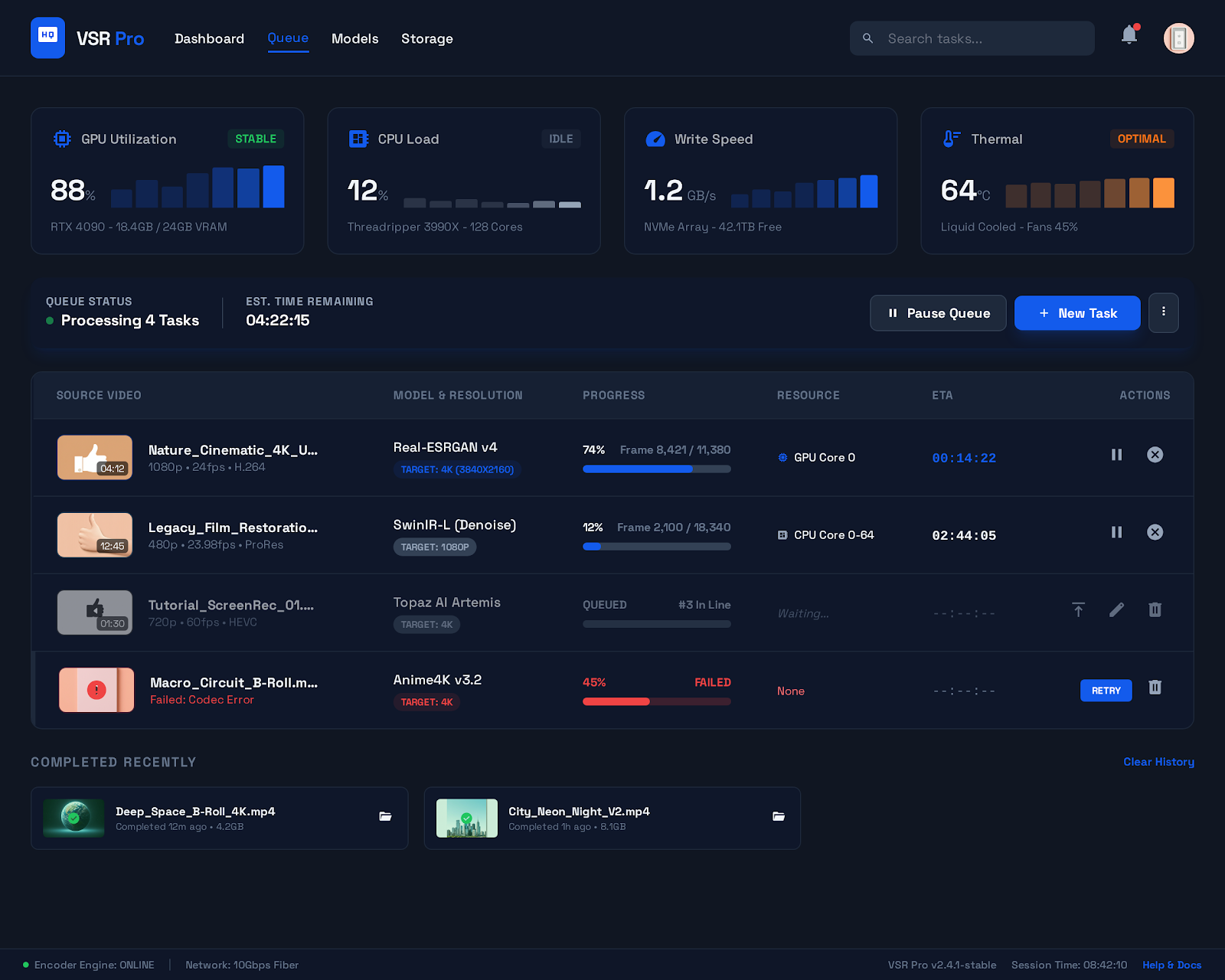
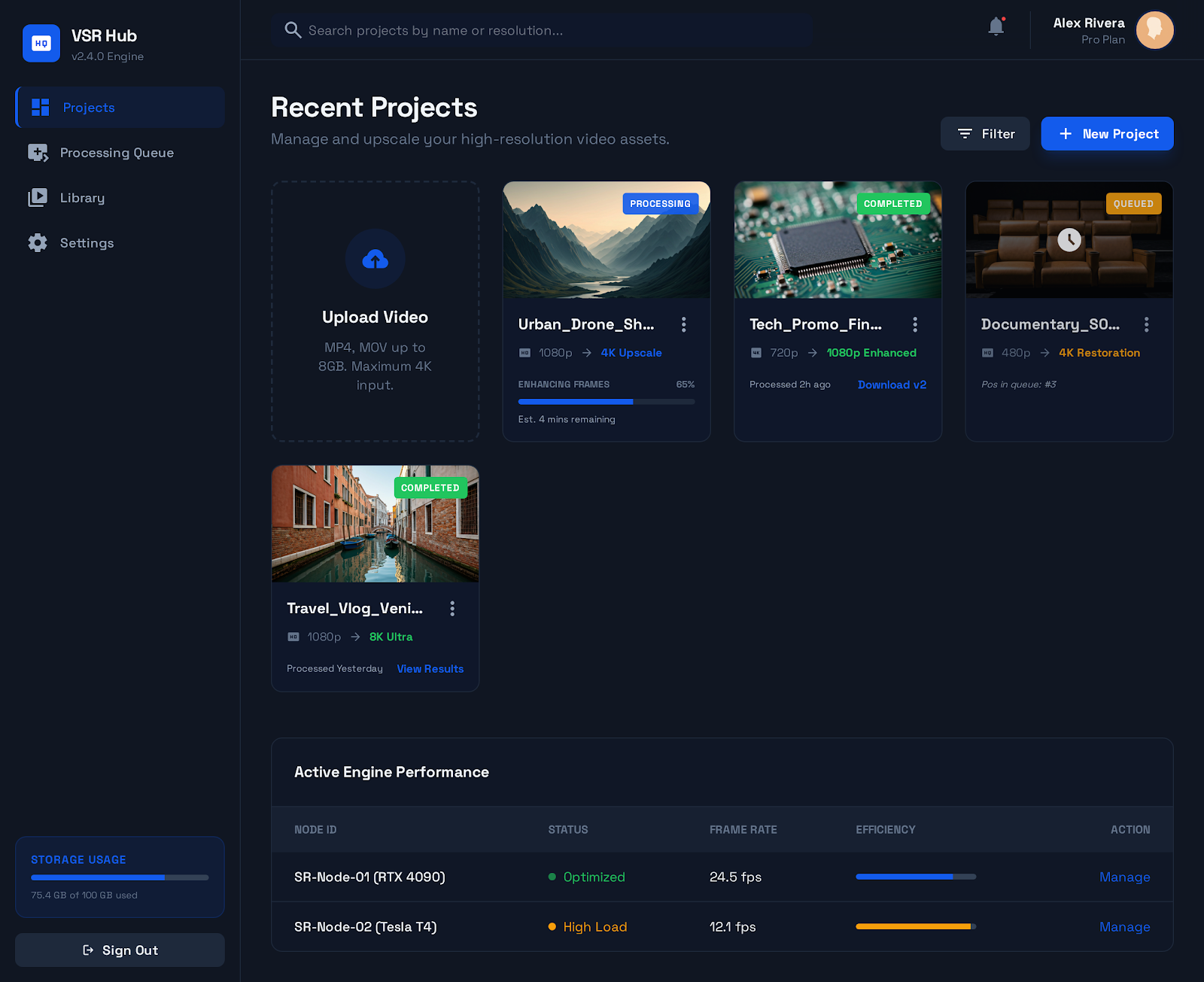
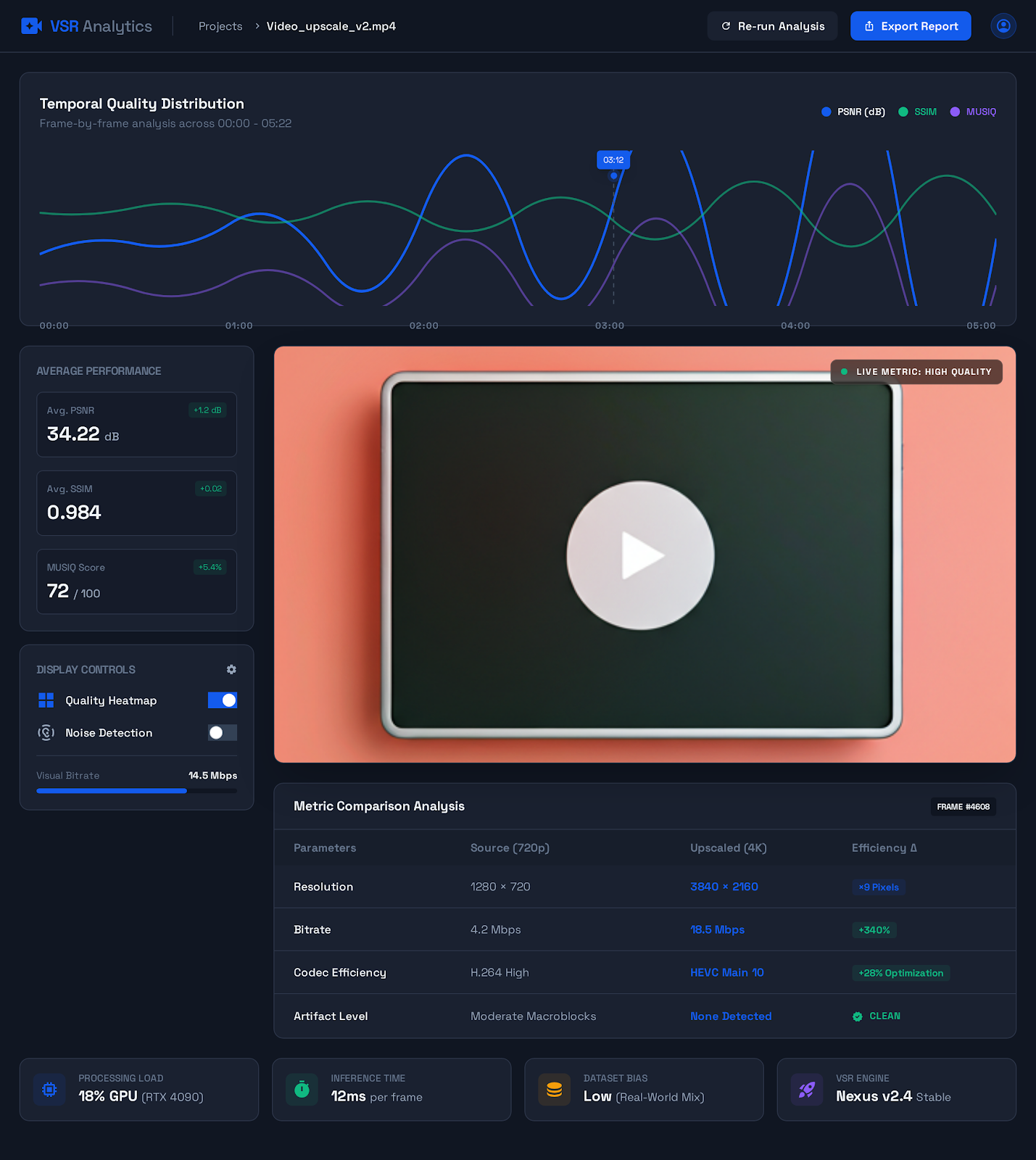
Operator Dashboard

Full visibility from queue to QC.

Monitor every run, inspect quality metrics, and manage batch processing from a single web surface.
Project hub dashboard interface
Project Hub
Runs, source groups, state transitions, and output visibility.
projects run status artifacts handoff
Quality analytics interface
Quality Analytics
Metrics, thresholds, and review-grade evidence.
metrics thresholds review
Batch queue interface
Batch Queue
Priority, throughput, and execution monitoring in one surface.
queue priority throughput
Deployment

From demo to production in one step.

Docker-native architecture designed for on-premise GPU clusters with Celery-based queue orchestration.
01
Containerized Services
Each AI model runs in its own Docker container with isolated dependencies and consistent GPU access.
docker isolated deps gpu passthrough
02
Queue Orchestration
Celery + Redis manages job scheduling, scene-level parallelism, and run state tracking across workers.
celery redis job queue
03
On-Prem GPU Cluster
Scale horizontally across GPU nodes. Each model service auto-discovers available hardware and manages VRAM.
docker gpu on-prem